
Ease
When I’m having a particularly hard time on a task I bring my attention to my body; it’s usually pretty stagnant and hunched over. My breathing is shallow and I have a glazed dead look in my eyes.
I invite ease into my body, I go for a walk and smile at myself. I breath fully like an athlete and stand like I’m strong.
I ask myself “what would this be like if it were easy?”
“How would my body be if this was a fun adventure?”
Make these adjustments and the rest follows.

The 5 Dollar version
Sometimes when projects or tasks seem too big to even begin, I give myself a stupidly short time frame and a simple prompt:
What’s the 5 dollar version of this?
It takes the pressure off the thing being done perfectly and makes space for an imperfect start to be made.
It also removes the daunting empty page.
Start with the 5 dollar version- then you’re in the game.
Stretching Capacity
Difficult periods don’t have to set us back or take us backwards five steps.
They can be increasing our capacity and growing the neuro-pathways for what we are capable of withstanding and growing through.
Let go to get going
Sometimes the best ideas allude you until you stop trying to find them.
Buffer time
It’ll save your schedule.
I have a habit of being very optimistic when it comes to scheduling my day. It starts well, it’s quite easy to stick to an hour of X task, then 45 mins of Y task in the morning.
It’s after lunch that things can go a bit wonky for me. I think it’s also tricky for me to think that far into the future for some reason. I can imagine doing a task now, but somehow don’t quite believe I’ll have time for it later. That may be because I historically don’t stick to schedules or spend longer than I said I would, so I don’t trust myself.
Yesterday, I had accidentally scheduled the afternoon like this.
Lunch
Task A: 1pm – 2pm
Task B: 2.20 – 3pm
Where’d that 20 mins at 2pm come from?!
The best thing is I didn’t have anything planned for that 20 minutes, so at best it was a surprise break and at worst it was extra time to finish task A.
Guess what? Task A ended but needing EXACTLY 20 minutes extra.
Had I not had the accidental buffer, I would have gone over time, been a bit ‘afternoon tired’, the rest of the day could have lost structure and my productivity would have gone out the window.
Be ambitious with you scheduling, yes!
But also be realistic AND be tactical with how you set it up.
Give yourself some buffer.
Pretend limits
Just because something is awesome or has gone really well so far, doesn’t mean it’s about to get bad.
There’s a belief among actors that if opening night is great, the second night will be a bad show.
But in reality, every show and every event in our lives is it’s own universe.
It can be great and then great and then great again.
They don’t have to relate to each other.
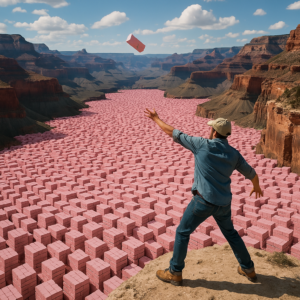
Bricks in the grand canyon
I heard the analogy that creating content for the internet is like throwing bricks into the grand canyon.
It takes a while to fill it up.
It reminds me of Youtuber who puts four videos up and wonders why she hasn’t got 1 million subscribers after a week.
You can’t fill the grand canyon with one brick. A thousand won’t do it. I don’t even think think one hundred million would do it (I have no idea)
But you keep chucking them in.
That’s the job. Be patient and do your work.
Ai prompt: a photo of the grand canyon filled to the brim with pink bricks and a man throwing in the last one.
Stack Value
It can be helpful to group output activities that take your time two ways:
Quick burn activities.
This is treading water. Putting out a social media post about your lunch or the latest trend. Sending a helpful ‘tid bit’ to your followers or clients. Completing a report that’s due or completing some ephemeral admin.
These tasks feel good; it’s busy-work that appears to be taking you places. Sadly these tasks won’t take you anywhere long term- it’s a bit like eating a complex carb; it burns quick and makes you sweat.
There is another category of tasks that don’t feel as satiating in the moment, but it’s the long arc they create over time that gives them the value.
Compounding activities.
This is creating content that contributes to your over all artistic voice. Outlining a book you will write. Creating a bible or guide that dictates how you complete a report. Creating a system to complete the admin that will come in over the years. These activities can be spotted easily because their results will last and remain relevant in perpetuity.
Don’t shovel your time into a black hole of fast burning activities.
Spend your time wisely on the tasks that stack over time.
Contribute to your over all arc. Create systems. Add a brick to your wall and build it to last. Write a word of your narrative.
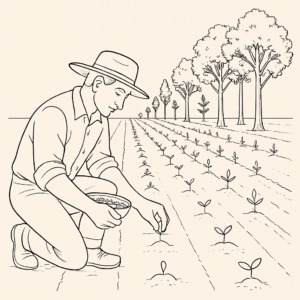
AI prompt: make a line drawing picture of a man planting a forest of seeds in rows, we see him planting one and as they stretch further into the distance they get taller into trees. The closer to him they are, they are mounds, then sprouts, then little trees until far away they are massive
The mess of inspiration
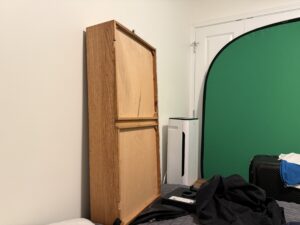
My room is a tip as I head to bed tonight (there is a drawer taken out of the set as a light stand)
But it is the carnage of a day well lived. I’m not interested in making a habit of it.
But I’m okay with it tonight.
Every Stitch
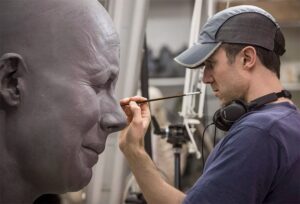
Listening to this interview Tim did with Richard at Wētā, I was really struck by what Richard had to say about the scale of the Gallipoli exhibition in Wellington. He was talking about the level of detail they went to get every detail perfectly accurate and in alignment with the larger than life vision.
To match the 2.5x scale of the people, they went to extreme efforts:
Because to make a larger costume you have to find a sheep with a two and a half times larger denier of hair density to what was used for the real costumes. And then you’ve got to weave it. You’ve got to loom it, and then weave it, and then build it into costumes. You can’t just use a sewing machine because the stitching won’t be big enough. And on and on and on it goes.
It would have been so easy to not go to that level of effort and detail. But I just love how Richard has linked the painstaking detail and process to respect for the purpose of the art:
We take it to that degree because you are trying to pay a depth of respect to the memory of the people. And if you shortchange the effort, you’ve shortchanged the respect to those people. These are veterans, right? They’re returned servicemen or men that lost their lives in service to our country. So what is it to us to make that extra 10 percent to try and get it as good as we can possibly get it?
This is such an excellent example of a purpose in action. A clear and passionate purpose will allow us to get to the extremes of what is possible in our work.