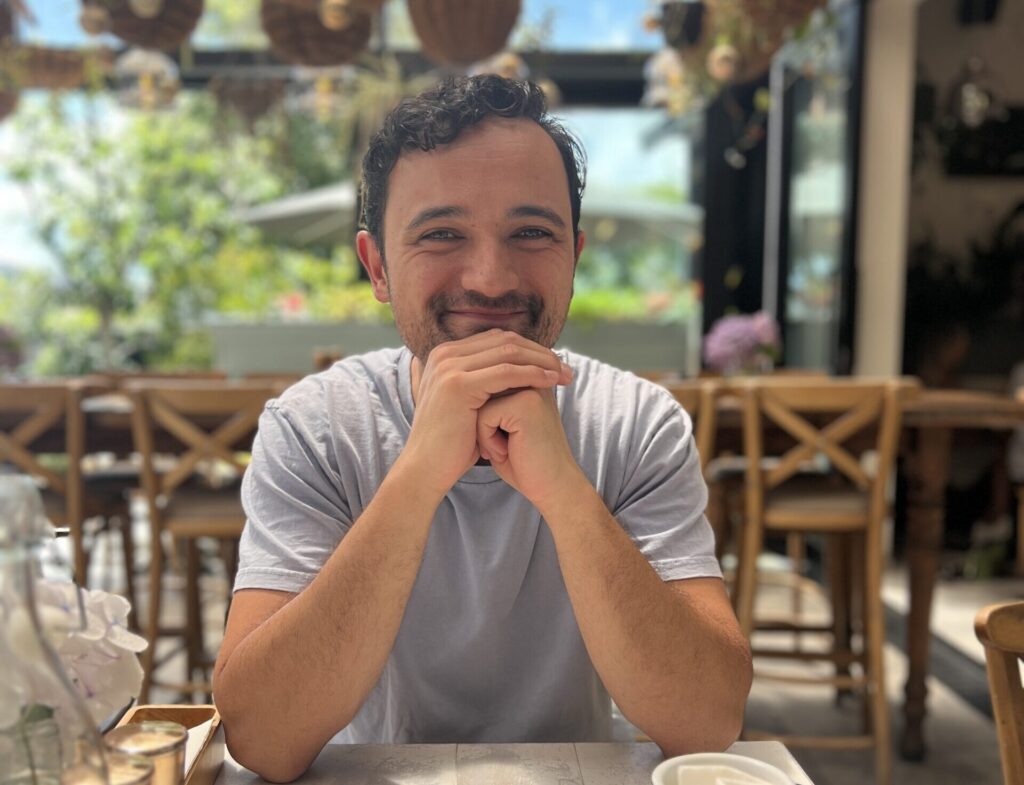
A magic moment is anything you really, really enjoy. A cool conversation with a stranger. Someone smiling at you for no reason. Sitting down to your favorite show with your favorite snack and just thinking, life is good.
We have to record our magic moments.
And I don’t mean pulling your phone out and filming yourself having a good time. I mean starting a list somewhere, a note on your phone, whatever works for you. So much happens every single day in our lives that our brains simply cannot store all of it. What we want to do is train our brain to remember the things that were actually good.
Because here’s the thing: your life is just a collection of memories.
If that collection is made up of the hard things, the tough moments, the stuff that dragged you down, then you’re going to feel like you’ve had a hard life. But if you start recording the awesome little moments you genuinely loved, you’re training your brain to notice them. You start unpacking your week and suddenly you’ve got ten, twenty of these magic moments sitting there.
And what happens if you keep doing that every single week, for a whole year?
You end up with a whole list of awesome stuff.
We have to record these things. Otherwise, we’re just going to forget them.
If I want a gentle evening, I make sure it looks and sounds like one.
For me that just means I make the lighting soft, I don’t move or speak too quickly and I make sure the volume of the house is low.
If you are ever having an experience you do not want to have, you need only look at your environment and see how it is contributing to the way you feel.
You can change your environment to change how you feel.
Have you ever tried tracking your food on a tracking app? If you can get past groans from your friends and family, there are a few other things that might get in the way…
One of those things is wanting to be perfect at it.
This happened to me. Having worked out the macros I needed to be consuming daily, I started my first day measuring every single thing I ate and it took AGES.
So long in fact that every time I tared my food scale I fantaised about giving up completely.
The problem wasn’t the food weighing, it was that I was trying to do the olympic version of it!
I went from NEVER weighing my food to weighing the oil I was about to cook my veges in.
Yeah, I know I’m groaning WITH you!
So instead of giving up, I thought :”Look, I’ll just try my best”
What did my best look like? Well, if I weighed ANY food whatsoever in a day, I won.
Strangely, by lowering my ‘standard’ I had actually raised it. I’ve heard it said that perfection is the lowest standard because perfection is impossible. So you’ve set a standard you know you can’t achieve so therefore you have NO standard!
So I figured my new standard was doable.
And it totally was. I felt zero pressure to weigh the oil (and the fumes it gave off)
I was just weighing the best I could in the time I had.
I was doing my best. You could say it was the easiest version. And if the 80/20 rule is to be believed you could say I was yielding most of the results from this level of efforts too.
The best part? I gradually became more exact in my measurements as time went on- but I did not START there. Where I am now with that particular habit stands on the shoulders of a simpler version of the habit.
Get momentum first, then worry about the details.
So if you’re trying something new, ignore the groaners and do the easiest version for now.
Once momentum gets going, you can weigh the fumes, the condensation and the breath you expel saying the name of the dish you’re cooking.
Recently I’ve noticed a pattern emerge in how I respond when people say “How are you?”
I mightn’t have noticed it if I only saw one or two people, but it happened five times so it really stuck out to me.
“Tired, but really glad to have some down time”
“Really busy, I just feel very behind”
“Yeah, it’s been a big few weeks”
Look, I’m an advocate for connecting to our true emotions and taking the bad with the good… but I’m also smart and I can see when patterns aren’t serving me.
The problem with the above responses is how I’m framing my experience for someone else. It’s a good litmus test because when someone asks how are you, you have to dilute it down to make it understandable in a sentence or two.
I also think these kinds of ‘it’s been hard but I’m surviving’ responses are so socially acceptable- people often nod and say things like ‘yeah, me too’.
It seems less safe, perhaps to say “I’m absolutely awesome!”
As if theres a fear that it’s weird to feel good or something.
My challenge to myself (and anyone else interested) is to choose carefully the story we tell others when they ask how we are.
Because it’s the same story we tell ourselves. And if we tell it enough times we start to believe it.
You want to teach more te reo in your class but you find yourself stuck on ‘kei te pēhea koe’. You decide you need to upskill! You find a te reo night class- great! You dedicate a couple of hours a night to learning the language and even manage to create some lesson plans for your students.
As teachers, we all want to be well informed. We want to have all the facts. We want to bring a level of expertise to the table so we can stand with confidence in front of our class, field any questions and extend the learning together in the uniquely alive environment of a classroom full of curious kids.
We want to be the experts in the room.
Don’t we all?
I mean surely we have to know everything about a subject before we teach it…right?
The truth is, expertise in any field is hard to define, time consuming to attain and just when you think you get ‘there’ there’s even more to learn.
It’s the beautiful thing about learning, but it’s a trap for teachers.
The real magic in teaching comes from releasing the need to be an expert. The most powerful educators I’ve seen in action weren’t experts, they were outstanding facilitators.
This need for expertise is even more rampant in New Zealand primary schools when it comes to te ao Māori. And trust me, I get it. To say the Māori people and language has been through a lot the last couple of centuries is an understatement. So this need to ‘get it exactly right’ makes complete sense. Teachers want to respect the Māori culture. They want to do right by our heritage and they definitely do not want to disrespect the culture.
Sometimes this prompts personal learning journeys for teachers; they deeply explore the language, the culture and their own relationship to it as a New Zealander.
Other times it creates a paralysis in teachers. They don’t have the time or the resources to become proficient in the language or reach a level where they would be comfortable to pass it onto their students.
While it appears that this is respect in action, it actually has the opposite effect. When we are afraid of getting it wrong as teachers, we pass down this fear to our students. They inherit this fear, the culture doesn’t get passed on and we create a whole new generation of people who do not claim or celebrate te ao Māori as our unique national asset.
I think we instinctively realise that we can’t know it all before we dive into something. We’d be stuck with most things if this were the case. We have to make do with what we have, right? Can you think of a time where you taught something without needing all the answers?
I certainly can…
When I was fresh out of drama school, I found myself teaching a night class for non-actors. I was 23 and felt out of my depth. I had to teach adults (some of whom were 20 years older than me) how to act.
Keep in mind, I had just graduated and after the whirlwind three years I actually felt more confused about acting than when I started. I didn’t feel like I knew nearly enough to teach a weekly two hour night class to 30 people!
I think the secret fear I had was that I would have to demonstrate ‘great’ acting and that just made me want to vomit. “I’m just as confused as you all are!” is all I wanted to shout.
It was my mentor that gave me the advice I’m giving you now. He told me I didn’t need to know it all. He told me I just had to hold space for the learning to happen.
Whoa. That’s good. “Hold space for learning to happen” …
“Well I can do that” I thought.
I gathered some of the exercises from acting school that interested me most and took them along to my first class.
He told me I didn’t need to know it all. He told me I just had to hold space for the learning to happen.
With my fresh perspective, I positioned myself as the one who brought the proverbial soccer ball and goal nets.
“I’m not the best in the world, but hey here’s the equipment we need to learn together”
I taught that class for a year and we had an outstanding experience. My ‘students’ grew not because I’m so great, but because I facilitated space for us all to try things out together.
Now I wasn’t ‘winging’ it. I knew our outcomes and had some ideas I wanted us to explore together. But I also didn’t pour hours into late night googling to have impressive facts to sound smart.
I just made a space in which excellent learning could take place; and last I checked us teachers are really good at that.
This is the same strategy I see in the most successful teachers we work with at Online Kapa Haka, they aren’t the teachers who know the most, they are the ones who let go of that need and pour all their effort into facilitating world class learning environments.
While the biggest part of implementing this is a perspective shift, here are a few practical steps you can do now to get the benefits immediately:
Step 1: Decide. Decide to release the need to be an expert.
Step 2: Clarify. Have a clearly defined question or outcome going into the class; What will we all learn together?
Step 3: Resource. Gather as much resource as you can to explore together with your students- not to cram before the lesson, but to use together.
Step 4: Environment. Create an environment conducive to trying things out. Ask your students what you can all expect of each other and how you all should behave in pursuit of that.
Step 5: Explore. With curiosity, explore the resources together and find the learning outcome together live in the room
If this feels uncomfortable to you, you’re not alone. Looking at this as a lesson plan makes me squirm a little bit too. What could look like a lack of preparation is actually yielding to the life of the classroom. Just like an actor shouldn’t over-prepare for a scene, so too should a teacher avoid killing the magic of learning by overcooking the lesson prep. The learning happens live in the room, not on the computer screen the night before.
You might also be thinking “Great, well where do I find the right resources?!”
In most cases it isn’t a lack of resource that trips teachers up but a lack of resourcefulness. Get more interested in the intention of your lesson and the environment you create and let that steer you to find resources that ignite those lessons.
The next time you feel that niggling feeling like you need to know more, remember that you only need to provide the tools and environment for learning to take place. Focus on being a world class facilitator, someone who makes magical and lively learning happen daily; because you’re already an expert at that.
When I was 23 I was tasked with teaching 30 adults how to act- I felt completely out of my depth.
It was a weekly class; two hours each Thursday night. I was only a couple of years out of drama school but the thing that really got me was that the oldest of my ‘students’ was 45.
I felt completely unqualified to teach this class. Despite my three years of actor training, I didn’t think I had any wisdom to share with these people- I was hardly an expert! And besides that, I felt like a kid compared to the people I’d be teaching who had full on careers and families.
My mentor from drama school was the one that changed my whole perspective. He told me I didn’t need to be some zen master of acting to run this class. He said “You know a lot of acting exercises, right?”
I said “yeah”.
He said “And you know the learning embedded in the exercises, right?”
I said “Of course”
“Then that’s all you need. You don’t need to be the best at archery, you just need to bring a bow, some arrows and a target. Then you can all do target practice together”
This changed everything. I realised I didn’t need to be an expert. I just had to bring what I did know and we could all explore the learning together.
The weight lifted off my shoulders and I walked into that class with confidence. And the confidence didn’t come from knowing everything, it came from knowing enough and having a willingness to learn more.
That’s all we ever need. I take this same mentality into every environment where I teach or learn.