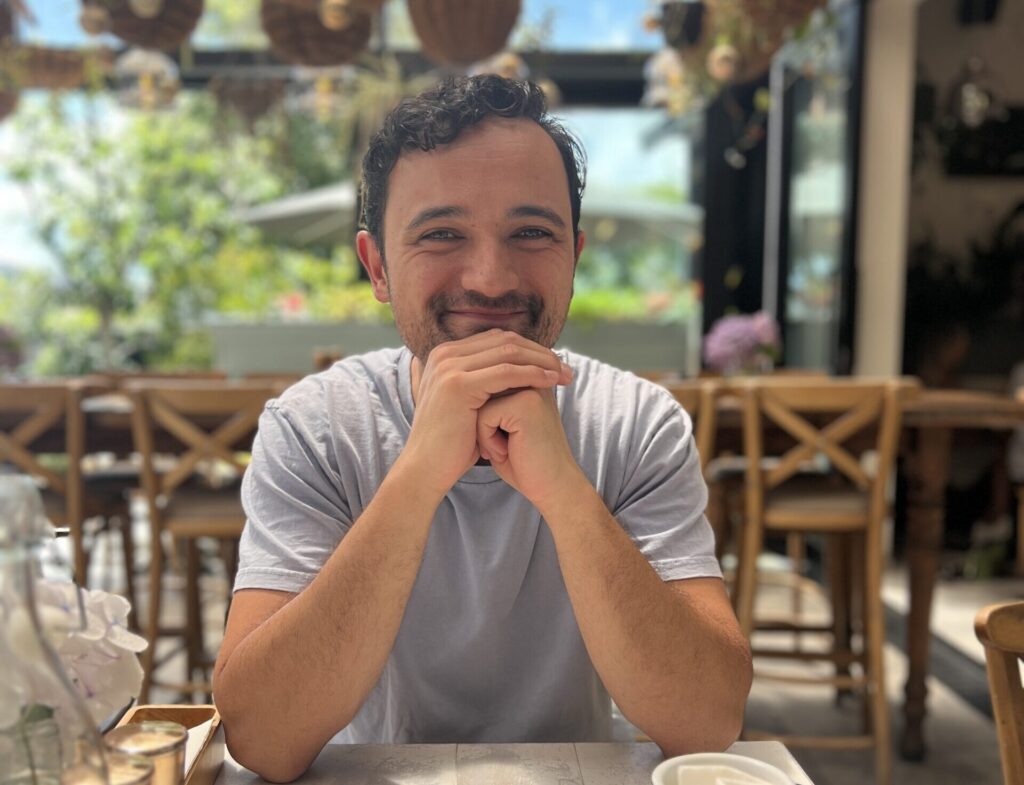
Being a teacher is one of my favourite things because I get taught all the time.
One thing kids teach me every time is to start where they are.
You can go in with the clearest intention of what you want to do, but if you jump straight there without properly clocking where you’re students are at, they won’t be with you.
To have someone follow you, you have to follow them a bit first.
Where is this group of kids at? What is required of me now?
When we start in the same place we can go to a shared place too.
I think it’s important to remember that life is a puzzle, not Russian roulette.
With a puzzle, you try a piece. Maybe it doesn’t fit. That’s fine, you put it down and you try another one. It probably won’t fit either. Still fine. You just keep trying pieces until one does. Nothing about a wrong piece ends the game.
Russian roulette doesn’t work like that. Get it wrong, and you don’t get to play again.
We do well to remember that most things in life are a puzzle, not Russian roulette. The piece that doesn’t fit isn’t a verdict. It’s just information. Put it down, pick up the next one, and keep going.
Our acting teacher, Jon, sends us a daily task. Something small we do as an actor, no more than five to fifteen minutes. Behind it is a simple idea: we are what we repeatedly do. You’re always an actor, and you can signal that to your brain just by doing the task.
What I love about these tasks is that they’re not product-based. We’re not trying to make anything. We’re just edging closer to our craft, building up reference material to draw on later.
That matters because as actors, we’re usually only ever working toward an end product: the audition, the rehearsal, the thing that needs to get done. We rarely get to just play, or sketch. Jon’s tasks are the opposite of that. They broaden our capabilities slightly, sure, but more importantly, they broaden our reference base.
Today’s task was to observe a person in the world through an actor’s lens, and try to figure out what drives them. How are they moving physically? What lens are they seeing the world through? How do they move in relation to the people around them? Then feel into what it would be like to begin playing them: how would you move your body to become this person?
I’m never actually going to play this person. But that’s not really the point. It feeds a longer body of work, a longer collection of references, that might inform something down the line… or might just broaden my reference base as an actor.
When you teach a class of kids there are two objectives.
The surface objective: The educational deliverable (times tables, a song, handwriting skills)
And then there is the meta objective.
The meta objective is the underlying lesson you want your students to absorb.
The beliefs in themselves or about the world and the people in it. It might be the ability to seek the answers they need or how to work as a team. Or how to solve interesting problems.
The meta objective is a bit of a through-line and won’t change much day to day.
Ask your self: What do I want my students to fundamentally believe?
The answer to a question like that is the meta objective. The meta objective is never to be spoken outloud- that’s too obvious. And it probably won’t go ‘in’ if you do.
It’s much more powerfully communicated through the way you interact, how you teach, how you speak, what you’e doing when your students think you think you’re alone.
Choose your meta objective wisely- it’s where all our power lies as teachers.
The first time I heard it, I thought it was a one off. Something that just this particular teacher struggled with. But the more I talked to different kaiako, the more this hidden fear popped up; this wasn’t the the outlier, this seemed to be the norm.
Back when I was teaching kapa haka in a handful of schools, teachers would come up to me all the time, beaming about the waiata we’d just learned with the kids:
“I’ve never heard the kids use so much reo! I’ve tried to do this before… but I’m scared of getting it wrong”
There it is, I’m scared of getting it wrong.
This is something we can all relate to; no one wants to be feel like they are wrong. But of course when it comes to te ao Māori, the stakes are so much higher. Everything we include in our classrooms comes in context of a long and complicated history in our country. This fear of getting it wrong is our mind (and heart!) doing all they can to respect and do right by our Māori people and culture.
The worst thing? This hidden fear is actually perpetuating the exact thing it’s there to supposedly counteract.
Think about it, where does this fear come from? Well, for me I want to take care of our sacred taonga. I want my students to respect the culture. I want them to say the right kupu and pronounce them beautifully. I want them to understand the context of our history and how it relates to them, their own culture and our place in the world.
It’s easy to see how the fear of getting it wrong can look like a safeguard, right?
One thing I know from working with tens of thousands of kids, watching my nieces and nephews grow up and indeed from my memory of being a kid… it’s that fear fear doesn’t nurture growth, it narrows it.
Fear based discipline is gross. There’s no place for purposefully induced fear in the classroom. Students shouldn’t be afraid to fail.
Neither should teachers.
fear doesn’t nurture growth, it narrows it.
When we feel and perpetuate the fear of getting it wrong with te ao Māori, we aren’t creating a respect and care for our taonga, we’re actually creating a fear based relationship with it.
And what we believe, our students tend to adopt. So the fear of getting it wrong is modeling the same fear in the next generation of New Zealanders and guess where that leads? Teachers don’t even try, kids never learn and our unique culture slowly fades into obscurity.
The alternative then is to model the beliefs, attitudes and behaviors we want in our learners. We may know this, but when fear grips us, it has a great way of making us forget the fundamentals. Our students are looking to us to lead them, and as leaders we have a responsibly to dance with our own fear and lead our kids to grow their confidence.
When I first started teaching, I’d pore hours over the actions and translations for the waiata I was teaching. I wanted to get it just right. Sadly my lessons always fell flat when I was focussed on perfection. Both because perfection doesn’t exist and because I was teaching from fear. It wasn’t until I saw a colleague completely light the classroom on fire with her kapa haka lesson that I had to rethink my approach…
What was she doing differently?
Outcome
I decided to do a bit of investigative interviewing to figure out her recipe for success. The first piece to her success seemed to be her outcome. She said that all she wanted to do was feel a sense of energy in the room. Whether teaching a new waiata or learning about similes and metaphors, she is hunting for that life in her students. Compare that to my outcome, which was to get it just right.
Resource
She also had a different approach to resource to me; where mine was linear, her’s was like an all you can eat buffet (the Pizza Hut one they used to have). I had an ABC approach, where I’d do ‘this’, then ‘this’ and hopefully we could then do ‘that’. My colleague on the other hand, knowing that she’d be much more relaxed, had a brimming resource pool. She didn’t rely on a single source, she brought videos, audio tracks, interviews, a few games, worksheets, resource pages and personal anecdotes. Knowing that her outcome was to bring the lesson to life, she had a myriad of things to pick from to follow the natural progression of the lesson.
Flexibility
The final bit was watching her bring it to life in action; and this is the beautiful thing about teachers, we all have our unique style. When we have an empowering outcome and we’re loaded up with resource, we have the luxury of dancing through a lesson with our unique way of teaching. When we know what we’re after (like how my colleague’s outcome was to see that sense of energy in the room) and we’re flexible in our approach, the possibilities for getting there completely open up and suddenly we’re free.
This kind of freedom feels like a world away from being fearful. And it’s this freedom that got me into teaching in the first place!
When I talk to teachers about this antidote to fear they sometimes say to me that the fear keeps them in check. They’re afraid that if they lose the fear they lose the respect for taonga Māori. To some, ‘respect’ isn’t a useful word. For some teachers the word ‘love’ suits a bit better. What is it to love the Māori culture? So if you think the fear is your safeguard, maybe a ‘love’ for our nations culture can be your new safeguard.
This kind of freedom feels like a world away from being fearful. And it’s this freedom that got me into teaching in the first place!
You might also feel resistant to working in this way because you may truly be completely wrong and deliver a terrible lesson! The truth it we always run this risk. The stakes are always high for us teachers. It’s our willingness to still play when the stakes are high that makes our work special. As with any lesson, do the best you can with what you have, get resourced up, ask for help and get playful. When your intention is to bring life to the learning and deliver it with curiosity and love, I don’t think you really can fail.
The fear of getting it wrong is so common and worse still it hides in plain sight disguised as a guardian of te ao Māori. But protecting something using fear is a bit like the plastic covering over my Nan’s couch. Sure, it’s not going to get spaghetti bolognese on it… but then we never get to enjoy it in it’s full corduroy glory. (No offense Nani)
Culture was never meant to survive behind glass. A waiata survives because people sing it imperfectly at first, courageously over time, and together. That’s how we bring te reo to life in our classrooms and more importantly, that’s how the unique culture of Aotearoa survives and thrives into the future.
Have you felt a similar fear of getting it wrong? Comment below and let me know; what strategies do you use to dance with your fear?