Post Category:

Pitch

Words change how we feel

“You’re a liar” vs. “you’re wrong” vs. “you’re mistaken”.

All of these could mean the same thing- but they have different levels of emotional intensity.

So when we speak to others we have a choice- and a responsibility- to be intentional about what we say.

We also have a responsibility to choose the words we say to ourselves.

Is this the end or the beginning?

Did you ruin it all or did you find another way not to get there?

Did you make the wrong choice or does everything happen perfectly?

It’s not about toxic positivity, it’s about intelligent naming.

Let’s choose words that help us and others.

You already know all you need for this moment.

Sometimes when I’m preparing for a presentation or to deliver some teaching, I get caught up in learning new things that relate to what I’ll be talking about.

Learning is great, and so is research- when we are delivering knowledge to others we should be as geared up as possible.

The problem comes in for me when the learning starts happening too close to the delivery.

I get all excited about some new stats or a specific study and want to include them in the talk. And the talk is tomorrow.

Not super useful.

Sure, we can teach from the book or refer to facts as we need but I find this disconnects me from the change I’m trying to make in the moment.

It also tells my brain a story that I’m ‘reaching’ for things, instead of deeply channelling truths I know.

It’s a bit like an actor learning all the lines and doing all the prep then ‘letting it all go’ when she steps on stage. We can’t experience that transformational flow while we’re trying to compute the fact that the play is set in Vienna in 1916… it doesn’t work.

You know what you know now and that is more than enough.

Our job isn’t to know more, it’s to deliver what we do know from our core.

Only one energy can win

At drama school we played a game that’s always stuck with me. We had been learning how a cast of actors can create a palpable feeling or energy in a room with their collective focus.

(Don’t you just love how ‘drama school’ that sounds!?)

Collectively we might direct our energy to the feeling of anticipation… or dread… or grief… or bliss.

You get the idea.

It was one of those- ‘is this really real or is this in our head’ moments.

But as we did the exercise, sure enough the chosen feeling flooded the room, to the extent even that if someone came into the room, they’d be able to sense the mood pretty easily.

Once we had done a few rounds of creating these moods in the room, our teacher split us up and allocated each group a different and apposing mood to evoke. I was in the group whose mood was ‘serenity’ and the other group had been assigned ‘chaos’.

‘Lol’, right?

So we, the serenity group, started off in the studio while the chaos group began out in the hallway. We were each to generate our mood and then the chaos group would come and join us… and we would see what happened.

I think you can imagine what happened. All our efforts to maintain, grow or share our serenity were bulldozed by the chaotic energy that had just entered.

Only one energy could win. Two couldn’t exist at the same time. One overthrew the other.

Now, it’s not to say there are hard and fast rules around what kinds of moods will ‘beat’ others, I don’t think it’s that simple. For instance, if we had persevered a bit with our serenity maybe chaos would have tired out and eventually we would have won.

Knowing that only one energy can win gives us the ability to see if we’re on the ‘winning’ side or not. To shift ourselves to create the equilibrium we desire in a room.

It makes me think of those classroom days when the kids are just completely hectic for what ever reason. I have in the past tried to hold onto my quiet energy and have of course become frustrated.

Instead what I’m experimenting with is shifting myself to something that stands a chance of facing off against their energy. And eventually finding a middle ground we’re both happy with.

But of course, it could all just be in my head 😉
Take responsibility for your remarkable results

What’s a remarkable result you created recently?

Sometimes lighting strikes in the classroom- for whatever reason you were absolutely on fire. You were off book, speaking from the heart and the kids were completely connecting to the learning material effortlessly.

When I have days like this I remember why I do what I do.

And then there’s the part of my brain that says it was a fluke and there was some special set of circumstances outside of my control that made the lesson happen like that…

I have to fight this part of my brain.

It says that remarkable results are outside of my control. That it all depends on what the kids ate, whether they got enough sleep or if it’s a cosy rainy day out there.

Sure, these things contribute. But the minute I start yielding responsibility to things like this, I stop myself.

What was awesome about that day in the classroom? How did I contribute to it being that way?

We can treat it a bit like a recipe. What did I do first? How exactly did I do it? And then what happened?

When I break it down like this I always find the patterns that worked. And the great thing about recipes is they can be replicated or experimented with.

If you’ve don’t it once before, then you can do it again. And I’ll do you one better; if someone else has done it once before then you can do it too.

Or how about the ultimate: If you can picture and imagine it, then you can create it.

Take responsibility for your remarkable results- then make more of them.

Praise in advance

Did you know that kids work the same as credit cards?

I use this fact to get kids engaged in a way that makes them feel awesome!

With a credit card you can use money now that you don’t have yet. It’s as if you have the money right now.

There’s two powerful words in there: yet and as if.

Let’s take full advantage of them shall we?

“Yet” presupposes that there will be something in the future (just not yet; like the money you’re spending in credit)

“As if” means we don’t need the reality to match the way we are behaving, we can act as if (I thank my actor training for this too- in acting it’s called the magic if)

Here’s how I apply “yet” and “as if” to draw kids into my lessons.

There’s a desired behaviour when I’m teaching; I want the kids to have fun, focus and curiosity. Not crawling up the walls excitement, and not dead eyed robots- something in between.

They’re not there ‘yet’

    When I know where I want them to be and use the word ‘yet’ on myself, I’m inviting in the possibility that they will soon be perfectly at the level of engagement I seek.

    Act as if.

      Here’s the sneaky part, I actively praise the behaviour I don’t see yet, but I act and speak as if it’s right there in front of me: “I love the way these people over here are focussing and having fun, who else can I see? Oh yes you are all SO GOOD at focussing your attention on me and having a great sensible time!!”

      I’m spending on credit here. They may not be perfect (yet!) but I’m nudging them toward perfect by praising them in advance.

      The game then is to be a heat seeking missile on any and all behaviour that is remotely in the direction of the desired outcome and double down on the praise until I’m not longer in credit mode.

      That attention is money in the BANK!

      Teaching a thousand kids at a time

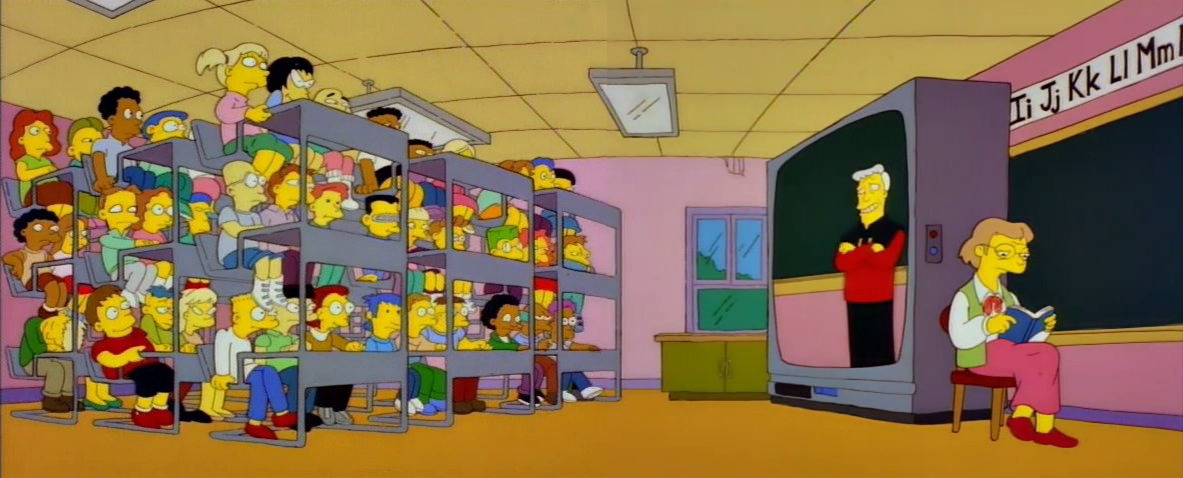
      I remember seeing on The Simpsons years ago a futuristic scene where there was a teacher beamed into hundreds of classroom tvs and teaching digitally. Here is a picture of it!

      It cracks me up that last week I was literally that guy. I have to admit I was a bit apprehensive about taking my teaching to a live zoom direct to kids. But I was blown away by how well it worked and how the lesson content translated.

      Here’s what worked:

      1. Personalisation. Just like in person, kids love to be seen and acknowledged. One of the best parts of having a screen to interface with meant every classroom was clearly labeled. A simple ‘hello xyz primary school, room 12 look at you go!’ Seemed like a rock star shout out for the kids!
      2. Get moving! The session I led was all about getting moving and speaking in Te Reo. The virtual-ness of the session didn’t stop us there either! I could see hundreds of classes up, moving and having a great time.
      3. Focus setters. A unique aspect of teaching through video is we can cast focus literally by having specific things on the screen. Look at this, then look at this, then this, then this. This was the same for the zoom, I could direct focus by curating the content on the screen. I could even select certain super star schools to showcase to everyone else.

      I never anticipated that zoom would be so additive to the particular type of lesson I wanted to deliver. Zooms don’t have to be boring and impersonal, the kids proved they can rock the classroom no mater where they are.

      Feelings not facts

      There’s what we’re actually teaching then there’s emotion we want our students to associate with it.

      How we say something is much more powerful than what we say.

      After all, information is freely available everywhere. We don’t need more people spouting facts- anyone can find the facts they need.

      What we really need are people to deliver learning in a way that moves us.

      Something I’m asking myself is constantly is this: What am I teaching and how can I create excitement and curiosity in my students?

      That can’t be outsourced. We need your humanness to connect the dots and deliver education with heart.

      Don’t spout facts, light up hearts.

      Call it something funny

      We can transform our students’ experience of something just by naming it something else.

      Would you rather do a ‘quiz’ or a ‘super expert field experiment?’

      Would you rather ‘practice a waiata’ a song or be ‘a Kapa Haka hero’

      What we call it matters. And it’s an easy adjustment. I like to think about ways I can make things sound more fun and interesting for my students.

      Better yet, you can let the activity live up to the name! You don’t have to jsut call it somehting fun then deliver the same old same old.

      Let the name you’ve chosen dictate the way in which you conduct that piece of learning or activity.

      A waiata practice might look different to facilitating a room full of kapa haka heroes.

      Magic in Meaning

      The magic of meaning

      One of my favourite things about kapa haka is that the actions in the songs are telling their own story. They mirror, match and extend the story carried by the words and the tune.

      We were working on the song E Minaka Ana in class yesterday. The kids and I got talking about the different words and how they linked to the actions we had learned:

      Kōrero: Our hands near our mouths.

      Kai: Our hands by our bellies.

      You get the idea. And its no surprise that their word/action retention went up.

      But something else happened too- there was more ‘flare’ to their actions.

      Suddenly because the tamariki had a deeper understanding of the meaning of each action and how they linked to the words, they leant harder into the theatricality and scale of them.

      This is the same when rehearsing a play. We pore over every word of a script, touching, saying, trying, discussing each syllable many times. It means in performance, the script is lit up.

      Touching each word and action with the kids does the same thing. It’s familiar ground; we’ve been here before and we know it.

      And when we perform, we take great pleasure and pride in sharing this mahi with others.

      Prime the ideal state, don’t plead for it

      The magic trick that gets kids to focus

      We’ve all got our favourite version of

      You call: “eyes on me”

      Kids respond: “Eyes on you!”

      I used to make the mistake of only using a focus call when the kids were already wriggly and losing focus.

      Recently I’ve been rehearsing the focus call with them while they are still on the ideal learning state.

      When they’re focussed, listening and engaged- I’ll do a couple of focus calls and then double down by reaffirming how well they brought their focus back.

      That way, when it comes to really needing to bring their attention back, I’m not ‘resorting’ to a focus call, but re-aligning to a previous state we were already at.

      Useful, inspiring and cool things

      Join my newsletter