Post Category:

Magic

Self Esteem

Where does self esteem come from?

It’s esteem for one’s self. A deep feeling of self security and worthiness. I think in the past I’ve tricked myself into thinking that we get this from others.

Yes, we’re told that what others say and think about us doesn’t matter- but it’s a mighty loud signal.

When we’re kids it’s the authority figures in our lives that shape our beliefs about the world and ourselves.

As we get older I suppose we continue giving authority to others.

Do other people think we’re good or strong or clever? Whether people see us doing things that signal our virtues becomes important.

Because of course if a tree falls in a forest and no one hears it, does it make a sound?

It does make a sound- but only the tree knows it.

Esteem for one’s self is about who you are when no one is looking.

Because when we do things that show we’re strong, kind, creative, clever and the only ones to see it is us, that’s when we build real self esteem.

You’ll fight every urge to talk about it or signal to others what you’ve done. But that erodes the real treasure.

Do the right thing and do it for you only. And do that over and over (and over).
It’s all music

When we’re working well together we’re in “harmony.”

When things move us they “strike a chord.”

When they deeply make sense to us they “resonate.”

Things that work perfectly are “singing” and when they’re running smoothly they’re “humming.”

Music is both emotional and systematic. The best things are.

Sure we can do our work- or we can make music.

I know which I choose to play.

Gifting beliefs

What is the greatest gift you can give your students?

Or anyone you lead or love.

Candy, obviously.

No, that’s a joke.

It’s belief. And before you switch off at the over used buzz word- I’m not going to tell you you need to believe in them- just hear me out.

It’s gifting them a belief about themselves or about the world.

I’m not talking about the generic ‘believe in yourself’ type, I’m talking functional beliefs.

Let me give you an example.

I had a friend who gifted me a belief.

She didn’t do it by sitting me down one day and saying “Hey, you should believe this”, but she modeled it- lived it and I saw how her world was different to mine.

And the belief was this: Strangers are nice.

That’s it. I didn’t know it, but I actually believed the opposite. I thought strangers were just that- strange. People I don’t know and so I shouldn’t care about and that I can’t expect anything from.

She gifted me a new belief about the world and so a whole new way of operating. The trickle down of a simple shift like this can’t be overstated- I’m a different guy for this new mind set.

So, the question is- what is a beautiful belief about life, the world or themselves you would want to gift to your students or loved ones?

Model that and give that gift to them each day until it’s part of them.

And give them some candy too.

Magic and generosity

What good is a card trick if no one picks a card?

When I was 8 I started doing magic. I was naturally happy playing on my own so magic suited me really well. I’d practice alone for hours and I loved the process of getting a move just right. It was super satisfying.

Problem was I was so shy I didn’t really perform for anyone.

I was practicing for hours but no one got to see the magic- not because I was being selfish or wanted to keep it all to myself- but because I was too afraid.

I think being too afraid to share your magic and being too slefish to share it are as good as the same thing.

We have to be generous enough to neck the nervousness of sharing our magic. To risk the trick going wrong and the ace of hearts not being their chosen card.

Whether you’re too shy or too selfish doesn’t matter.

Get out of your own way and ask them to pick a card.

Being playful is better than having good ideas

Why being in a good mood is better than being a genius. (Heck- maybe play IS genius..!)

So every day I make a little movie and post it online- it’s been a commitment to myself this past year and has taken me the full scenic route of the artist’s journey:

This is great!

Okay this is really hard.

Wow I hate this.

Hang on…

No, yes I hate this.

Actually I really liked that one

Okay no one else liked that one…

It’s been a rollercoaster and one thing I’ve recently learned is it’s more valuable for me to be playful than to have a good idea.

Some days I’ll get hung up on the ‘perfect’ premise and when I finally get to filming it I’ve got nothing in the tank and it falls flat.

Other days I’m simply in a playful mood and a so-so idea comes off really well. The state I’m in makes the execution more convincing or maybe the play and fun I’m having comes through in the final thing.

I also like that I am in control of how playful I am- I’m not really in control of how good my ideas are. So I can focus on my mood and do the best I can with what ideas I have that day… and if I happen to have a great idea then I can meet that with the energy it deserves too.

Bit of a win-win if you ask me.

Be in a playful mood- a lot solves itself after that.

Teaching a thousand kids at a time

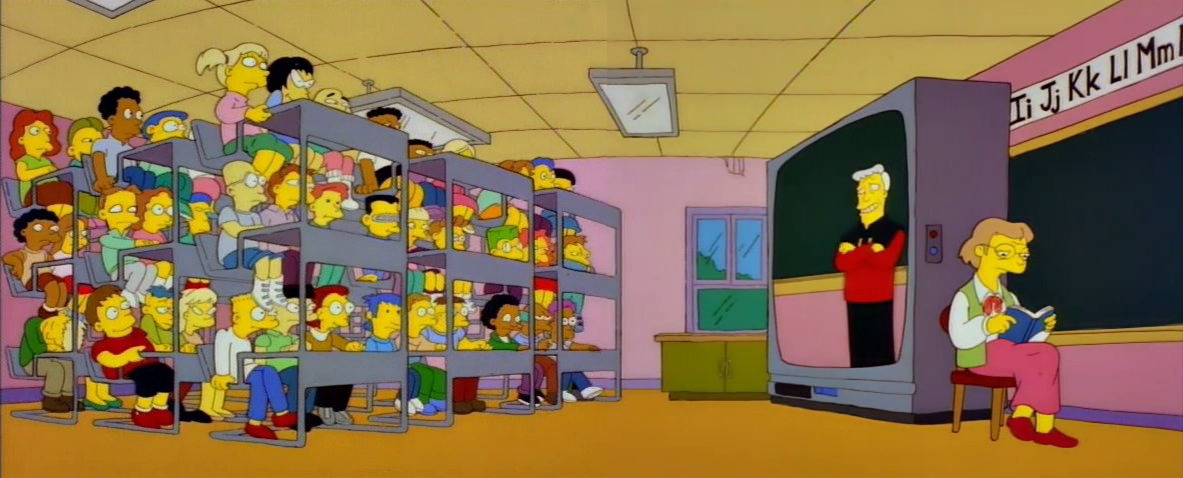
I remember seeing on The Simpsons years ago a futuristic scene where there was a teacher beamed into hundreds of classroom tvs and teaching digitally. Here is a picture of it!

It cracks me up that last week I was literally that guy. I have to admit I was a bit apprehensive about taking my teaching to a live zoom direct to kids. But I was blown away by how well it worked and how the lesson content translated.

Here’s what worked:

  1. Personalisation. Just like in person, kids love to be seen and acknowledged. One of the best parts of having a screen to interface with meant every classroom was clearly labeled. A simple ‘hello xyz primary school, room 12 look at you go!’ Seemed like a rock star shout out for the kids!
  2. Get moving! The session I led was all about getting moving and speaking in Te Reo. The virtual-ness of the session didn’t stop us there either! I could see hundreds of classes up, moving and having a great time.
  3. Focus setters. A unique aspect of teaching through video is we can cast focus literally by having specific things on the screen. Look at this, then look at this, then this, then this. This was the same for the zoom, I could direct focus by curating the content on the screen. I could even select certain super star schools to showcase to everyone else.

I never anticipated that zoom would be so additive to the particular type of lesson I wanted to deliver. Zooms don’t have to be boring and impersonal, the kids proved they can rock the classroom no mater where they are.

Loud and proud; strong and wrong

It’s generous to embarrass yourself.

At drama school we’d often get the instruction from our tutors to be “loud and proud, strong and wrong”.

It’s an encouragement to be bold in your failures and loud in your attempts.

If you weren’t committing fully to a scene: “Loud and proud!”

If you were unsure what choice to make in a scene: “Strong and wrong!”

Being lukewarm in your choices as an actor doesn’t help anyone; we need to see clearly where the problem is. Or indeed be blasted away by whats working.

This has served me well in the classroom too.

The years of actor training and rehearsal rooms have conditioned me to put myself out there more than most kids are used to.

I have less rules about how I need to be and I have a very low threshold for trying things out.

Yes, it means I’m often wrong or look a bit silly.

And that’s great. LET me be the ‘wrongest’ in the room.

By modeling ‘loud and proud, strong and wrong’ I want the kids to see how safe they are to try things out. After all, how could they possibly look as silly as THIS guy!?

It’s not about being zany for attention’s sake. Or being weird to be different.

It’s about whole heartedly trying.

“Loud and proud, strong and wrong” is about giving it your best shot.

Because really trying is a whole lot harder than flailing your arms about to be different.

Be bold in your failures and and loud in your attempts.

Give your week a title

Here’s something I’ve been trying out recently. What we call things matters. If I say to you, do you want to go on a walk you might say yes- but if I said do you want to join me on my sunset adventure you might get your Indiana Jones hat ready.

We can be activated by words that light us up. Acting coach Larry Moss talks about words that ‘carbonate’ an actor. When scoring a script with action verbs, the word ‘punish’ might be really exciting to play for one actor but the word ‘obliterate’ really gets another going.

It’s no secret that having ‘Week 29’ written on your calender isn’t going to move anyone to action. So how about naming your week something that makes you laugh, makes your excited or conjures up your most creative self to tackle the week ahead.

Names like:

Magic moments and legacy building

Or, Forging futures and being the best brother

I don’t know what it is for you- but giving your week a name is better than not, I reckon.

Oh- and write it somewhere you can see it easily, that’s important!

Reading helps productivity

There’s a nasty rumour going around. (And you have to be careful of rumours; if you believe them they might become true)

It says that reading steals your time. It says “there’s not enough time for reading”

This rumour tells everyone that there isn’t enough time in the day to read, that being swept up in a fictional world is a waste of time and when there’s something else to be done – anything – then you should do that.

Maybe (just maybe) when you finish all your work (that never happens) THEN you’ll have time to read.

It’s a nasty rumour. Luckily someone warned me about it (a bit like how I’m warning you right now).

The truth is, reading makes you more productive. It tells your brain that there’s more than enough time. Don’t leave reading for when you have time, read to MAKE more time.

Don’t read in spite of having a lot to do, read because of that.

Don’t believe the lies. Open a book.

The best teachers are improvisors

I love improv. To me it’s like a playful conversation with your best friend. And I also think teaching is a bit like a conversation. A transfer of knowledge or a creating of connections for a student. To have teaching sessions that are as alive and vital as an improvised scene holds the potential for magic. The best improvisors will tell you it’s this playful spirit that is part of the secret. But what does it actually mean to be playful?

Listening. The first secret to great improv is listening- and there a few different ways to listen. More on that tomorrow…

Useful, inspiring and cool things

Join my newsletter